
PROJECT UPDATE
SEPTEMBER 28, 2026
SHARE
Building a Transit Network Madera Can Count On: The Microtransit Feasibility Study Reaches Completion
4 MIN READ

Josh Albertson
Director of Advisory Services
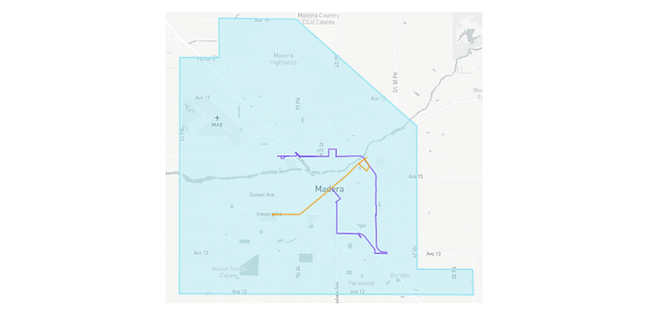
Recommended Service (Source: Flexlynqs)
In May 2026, Flexlynqs completed the Madera Metro Microtransit Feasibility Study, a planning initiative to reimagine how public transit serves the residents of Madera, California, and to build a network the community can rely on.
For many Madera residents, public transit is a necessity. It gives people the independence to handle every part of daily life, from essential trips to medical appointments, work, and the grocery store to the social, recreational, and community outings that keep them connected. For riders with few transportation alternatives, any gap in the transit system can become a daily obstacle.
At the same time, fixed-route ridership had been declining, with some routes seeing particularly low use, while on-demand ridership and interest were growing. These trends raised questions about whether the system was meeting riders’ needs and making effective use of the City’s transit resources.
The initiative began by examining whether an exclusively on-demand model could better serve riders than the existing fixed-route network. However, early data analysis and community input showed that improving transit would require a more tailored approach than on-demand service alone.
What the Study Examined
The study combined traditional transit planning with detailed data analysis, technology assessment, service modeling, and community engagement.
At the service level, the team evaluated the performance of individual fixed routes, including ridership, productivity, operating costs, and how efficiently service hours were being used. The analysis showed substantial differences between routes. Some corridors continued to support relatively strong fixed-route demand, while others carried comparatively few passengers despite requiring significant operating resources.
The study also compared Madera's performance with peer transit systems. This helped put local costs and productivity in context and reinforced the need to examine whether the existing mix of services was the most effective use of available funding.
Trip and demographic data added another dimension. Mapping demand revealed a combination of concentrated travel along several major corridors and more dispersed trips throughout the broader community. Those patterns present a common challenge for smaller transit systems: fixed routes work best where demand is concentrated, while lower-density and less predictable travel can be difficult to serve efficiently with a scheduled bus.
Community engagement added the rider perspective. Residents identified needs that could not be captured through operating statistics alone, including better regional connections, easier trip planning and booking, clearer information about available transportation options, and service that better accommodates trips outside traditional commuting periods.
The result was a much broader planning question than whether Madera should "implement microtransit." The real challenge was determining which service model was best suited to each type of trip.

Two Findings Behind the Redesign: Underused Routes and High per-Passenger Costs (Source: Flexlynqs)
What the Data Revealed
One of the strongest lessons from Madera was that transit demand and transit productivity are not the same thing. Demand for mobility clearly exists. In fact, the use of flexible, demand-responsive service had been increasing even as some fixed routes continued to struggle. But demand was distributed differently throughout the community.
Certain corridors had enough concentrated activity to justify frequent fixed-route service. Elsewhere, origins and destinations were too dispersed for a conventional route to serve them efficiently. Regional travel, particularly trips to Fresno, presented another challenge entirely. This led the project team away from an all-or-nothing decision between fixed-route transit and on-demand service. Instead, the analysis pointed toward a blended network in which each service type performs the role it is best suited to perform.
The Plan
Guided by the analysis, the study laid out a comprehensive plan to reshape Madera's transit around how people actually travel. Key elements include:
1. Eliminate the two lowest-performing fixed routes. The Blue and Green Routes would be discontinued, freeing resources for service that reaches more riders.
2. Enhance the remaining fixed routes. The Purple and Orange Routes would gain more direct routing, more reliable headways, improved travel-time reliability, and up to a 2x improvement in frequency.
3. Introduce city-wide on-demand service. This new service would replace the traditional Dial-a-Ride experience while complementing the fixed-route network.
4. Extend service hours. Mobility-on-demand trips would be brokered to transportation network companies during early mornings and late nights, filling coverage gaps at the edges of the day.
5. Launch a Fresno pilot. This program would connect Madera residents to Fresno for medical and personal appointments, directly addressing the healthcare-access gap riders identified.
The Road Ahead
Madera's circumstances are local, but the need for this type of analysis is widespread. Small and mid-sized transit agencies across the country face the same tension between coverage, productivity, affordability, and rider expectations. Many are also evaluating new mobility technologies while trying to determine where those tools genuinely improve service rather than simply add another platform to manage.
The Madera Metro study offers one approach: begin with how people travel, evaluate each service type based on the role it can realistically perform, use technology where it supports that operating model, and test the resulting ideas against both data and community experience.
With the planning work complete, Madera can now move from evaluating those possibilities toward implementation.
To learn more about the Flexlynqs + Madera Metro initiative, watch the video below.
Madera The Microtransit Feasibility Study (Source: Flexlynqs)

CONTACT
Let’s Work Together